
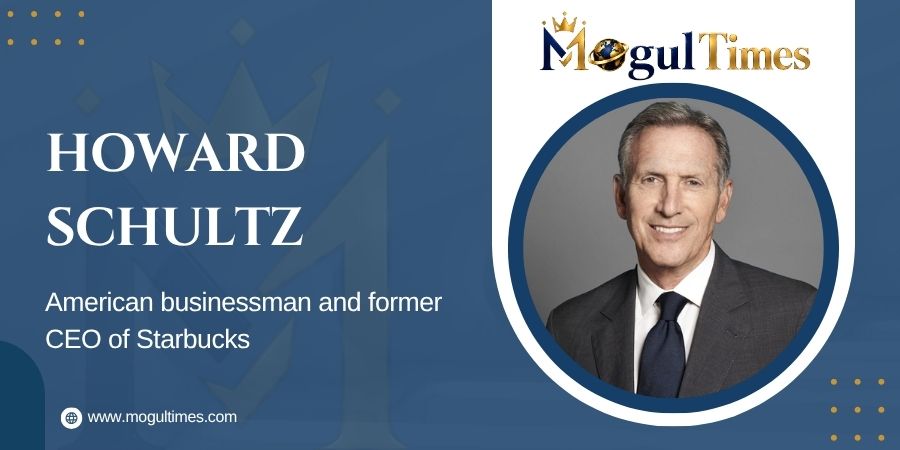
Howard Schultz transformed Starbucks from a small Seattle coffee business into a global coffeehouse brand by combining aggressive expansion with a strong focus on customer experience and employee benefits. His rise is especially notable because he grew up in the Canarsie public-housing projects of Brooklyn, New York, before building a career that eventually took him to the leadership of one of the world’s most recognizable companies.
Schultz’s story is not simply about selling coffee. It is about recognizing an overlooked business opportunity, turning personal experiences into leadership principles, and building a company around a repeatable customer experience.
Where did Howard Schultz’s journey begin?
Howard Schultz’s journey began in a working-class Brooklyn family, where his childhood experience with financial insecurity shaped his views on work, opportunity, and employee welfare. His father worked various blue-collar jobs, and Schultz later described seeing his father struggle after suffering a workplace injury without meaningful financial protection. That experience became an important influence on how Schultz thought about employers and their responsibilities.
Schultz attended Northern Michigan University and became the first person in his family to graduate from college. Before entering Starbucks, he worked in sales and marketing, including positions at Xerox and the housewares company Hammarplast.
His professional path changed in 1981 when he first visited a small Starbucks store in Seattle. At the time, Starbucks was primarily a retailer and roaster of whole-bean coffee rather than the international coffeehouse chain it would eventually become. Schultz joined the company in 1982.
That distinction matters because Schultz did not invent Starbucks. He identified a larger possibility inside the business.
How did Italy change the Howard Schultz Starbucks journey?
Italy changed Schultz’s understanding of what Starbucks could become because his 1983 trip to Milan exposed him to espresso bars that functioned as social spaces rather than simple beverage retailers. He returned to Seattle convinced that American consumers could embrace a similar coffeehouse experience built around conversation, community, and handcrafted drinks.
Starbucks initially resisted the idea of dramatically changing its business model. Schultz responded by testing the concept himself.
In 1985, he founded Il Giornale, an Italian-inspired coffeehouse that used Starbucks coffee beans. The experiment gave Schultz a laboratory for proving that the coffeehouse model could work in the United States.
The sequence was critical:
- 1981: Schultz first encountered Starbucks.
- 1982: He joined Starbucks.
- 1983: He experienced Milan’s espresso-bar culture.
- 1985: He launched Il Giornale.
- 1987: Il Giornale acquired Starbucks’ assets.
- 1992: Starbucks went public.
In 1987, Schultz and his investors raised approximately $3.8 million to acquire Starbucks’ name, roasting plant, and six Seattle stores. Il Giornale subsequently adopted the Starbucks name.
That acquisition became the decisive turning point in the Howard Schultz Starbucks journey.
What did Schultz actually change at Starbucks?
Schultz changed Starbucks from primarily a coffee retailer into a coffeehouse experience built around premium products, human connection, and a consistent physical environment. His central idea was that Starbucks could become a “third place” between home and work where people could meet, relax, and connect.
The concept created a business model with several reinforcing elements:
| Strategic focus | Schultz’s approach |
|---|---|
| Product | Premium coffee and espresso beverages |
| Experience | Comfortable, consistent coffeehouse environments |
| Customer | Personal connection and repeat visits |
| Employees | Called “partners” rather than simply employees |
| Expansion | Replicate the experience across markets |
| Brand | Build recognition around coffeehouse culture |
The strategy worked because Starbucks was no longer competing solely on the quality or price of coffee. It was selling an experience that customers could repeatedly recognize.
The company’s growth illustrates the scale of that transformation. When Schultz’s investor group acquired Starbucks in 1987, the business had six stores. Starbucks later became a publicly traded company in 1992 with 165 stores.
Why were Starbucks employees central to Schultz’s strategy?
Schultz believed Starbucks could not create a strong customer experience without investing in the people delivering it, making employee benefits a central component of his leadership philosophy. Starbucks introduced comprehensive healthcare benefits for eligible full- and part-time employees in 1988 and launched Bean Stock in 1991, giving eligible employees stock options and reinforcing the company’s use of the term “partners.”
The approach was unusual for the retail industry at the time.
Schultz’s philosophy connected employee treatment to customer experience:
Better employee experience → stronger engagement → better customer interaction → stronger brand loyalty.
The strategy also reflected his childhood. Growing up in public housing had exposed Schultz to economic insecurity, while his father’s experience with workplace hardship influenced his belief that employers could play a larger role in people’s lives.
Starbucks eventually expanded the philosophy beyond stock ownership and healthcare. During Schultz’s leadership, the company also introduced programs including college tuition assistance and other employee benefits.
How did Starbucks become a global company?
Starbucks became a global company by systematically replicating its coffeehouse concept while adapting the brand to international markets. After building a stronger U.S. foundation, the company expanded internationally, opening stores in Japan and Singapore in 1996 and continuing its global rollout through the following decades.
The expansion strategy depended on consistency.
Customers entering a Starbucks in different cities could expect recognizable elements:
- Similar store design
- Consistent beverage preparation
- Familiar branding
- Barista-led service
- Premium positioning
- A recognizable social environment
This consistency helped turn Starbucks into more than a regional coffee company.
By the time Schultz stepped away from Starbucks’ executive leadership in 2018, the company had grown from 11 stores when he took control to more than 28,000 stores across 77 countries, according to Starbucks. The company also reported that its stock price had gained approximately 21,000% from its 1992 IPO to Schultz’s departure as executive chairman.
What makes the Howard Schultz Starbucks journey significant?
The Howard Schultz Starbucks journey is significant because it demonstrates how a founder-like leader can create enormous enterprise value by changing the meaning of an ordinary product. Coffee itself was not new; Schultz’s innovation was packaging coffee into a repeatable cultural and commercial experience.
His most important strategic moves included:
- Recognizing an unmet customer desire: Schultz saw that Americans could embrace the social ritual surrounding espresso.
- Testing before scaling: Il Giornale provided proof that the coffeehouse concept could work.
- Building around experience: Starbucks became associated with atmosphere, service, personalization, and community.
- Investing in employees: Benefits and stock ownership supported the idea that employees were essential to the brand.
- Scaling systematically: The company replicated its core experience across cities and countries.
- Maintaining premium positioning: Starbucks avoided becoming simply another low-cost coffee retailer.
The lesson for entrepreneurs is practical: transformational businesses often emerge when leaders stop asking how to sell an existing product and start asking what larger experience customers actually want.
How large is Starbucks today?
Starbucks has expanded far beyond the scale Schultz inherited, although the company continues to evolve under new leadership and strategies. Starbucks reported approximately 40,990 stores at the end of fiscal 2025 and $37.2 billion in fiscal-year revenue, while its January 2026 company profile described the brand as operating in more than 80 markets.
The scale shows how far the company traveled from its early Seattle roots.
At the same time, Starbucks continues to face the normal challenges of a huge global retail organization, including changing consumer expectations, labor costs, international market conditions, store economics, and the need to keep the coffeehouse experience relevant.
That makes Schultz’s legacy more nuanced than a simple growth story. His achievement was creating a system that could scale while keeping the brand anchored to a recognizable human experience.
What can entrepreneurs learn from Schultz’s rise?
Entrepreneurs can learn from Schultz that extraordinary growth often begins with a clear insight about customer behavior rather than an entirely new product. His most consequential idea was that coffee could serve as the foundation for a place people wanted to spend time in, and he built the company around that insight.
The broader business principles are straightforward:
- Observe successful ideas in other markets. Schultz saw the potential of Italian café culture and adapted it rather than simply copying it.
- Prove the concept. Il Giornale allowed him to test his vision before acquiring Starbucks.
- Build a repeatable experience. Global brands require systems that can reproduce quality.
- Invest in the people delivering the product. Customer experience begins with the workforce.
- Think beyond the product category. Starbucks competed on experience, not just coffee.
- Scale only after finding the formula. Expansion becomes more powerful when the underlying model is already proven.
The most durable part of Schultz’s story is therefore not the number of stores Starbucks eventually opened. It is the strategic shift that made that growth possible.
The lasting legacy of Howard Schultz
Howard Schultz left Starbucks with a legacy defined by global scale, brand-building, employee investment, and the transformation of coffee into a lifestyle experience. His leadership helped take a company with a handful of stores and turn it into a global organization recognized in markets around the world.
His personal story gives that transformation additional meaning. A child raised in Brooklyn public housing eventually became the executive behind one of the world’s most recognizable consumer brands.
The central lesson is not that hardship automatically produces success. It is that Schultz converted experiences from his early life into convictions about opportunity, dignity at work, and the importance of creating something larger than a transaction.
That combination—personal conviction, customer insight, disciplined execution, and scalable systems—is what made his Starbucks story one of modern business’s most closely studied transformations.
Frequently Asked Questions
How did Howard Schultz start with Starbucks?
Howard Schultz joined Starbucks in 1982 after discovering the company while working in sales. After becoming inspired by Italian coffeehouse culture, he left to establish Il Giornale and later used that company to acquire Starbucks’ assets in 1987.
Did Howard Schultz grow up in public housing?
Yes. Schultz grew up in the housing projects of Brooklyn, New York. His childhood experience with financial insecurity influenced his later views on employee benefits, opportunity, and corporate responsibility.
When did Starbucks become publicly traded?
Starbucks completed its initial public offering in 1992. At the end of fiscal 1992, the company had 165 stores.
How many Starbucks stores existed when Schultz took over?
The exact historical count varies depending on whether the reference is to the six stores acquired by Il Giornale or the 11 stores Starbucks cites when describing Schultz’s leadership period. Starbucks states that Schultz’s leadership grew the company from 11 stores to more than 28,000 stores in 77 countries.
From Brooklyn to a Global Brand
Howard Schultz’s rise shows how a powerful business vision can emerge from a deeply personal understanding of opportunity and insecurity. He did not create coffee, but he transformed the way millions of customers experienced it—and built the systems, culture, and brand needed to take that idea worldwide.
For entrepreneurs, the Howard Schultz Starbucks journey offers a clear reminder: the biggest opportunities are sometimes hidden inside ordinary products, waiting for someone to see the experience that could be built around them.
Also Read: The Nelson Mandela Journey That Turned Division into Unity