
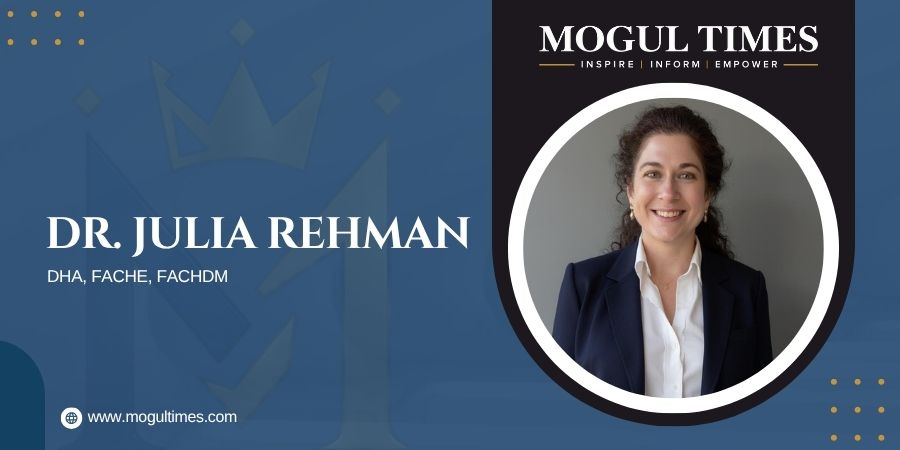
Healthcare transformation is no longer driven by clinical innovation alone. The industry is being reshaped by data, artificial intelligence, digital infrastructure, changing patient expectations, population health priorities, and increasingly sophisticated approaches to organizational governance. Yet for Dr. Julia Rehman, DHA, FACHE, FACHDM, the conversation has never been about technology for technology’s sake. Her more than 18 years of healthcare leadership across the United States, United Arab Emirates, Saudi Arabia, and India have been shaped by a more fundamental question: how can healthcare organizations make better decisions, improve access, support clinicians, and ultimately deliver better outcomes for the populations they serve?
That perspective was formed long before artificial intelligence became one of healthcare’s most prominent areas of discussion. Rehman’s professional foundation was built in the U.S. healthcare environment, where her work included population health, patient access, analytics, and engagement with diverse and underserved communities. Those experiences gave her a practical understanding of the realities behind healthcare data and performance indicators. They also established a principle that continues to influence her work today: technology and analytics have value only when they help organizations respond more effectively to the needs of patients and communities.
Her career subsequently expanded across health systems, government and regulatory environments, enterprise analytics, payer and provider performance, data governance, and digital transformation. From Presbyterian in New Mexico to healthcare data science and analytics work within MNGHA in Saudi Arabia and regulatory and population-level analytics with the Department of Health Abu Dhabi, Rehman has developed her perspective from inside complex healthcare environments rather than solely from an advisory position. Her work has included initiatives at Presbyterian that contributed to approximately $18 million in savings and a 17% reduction in cancer readmissions, demonstrating how data-informed healthcare leadership can translate into measurable organizational and patient outcomes.
As the Founder and Chief Operating Officer of Kota Kompany LLC, Rehman now brings this accumulated experience into an independent advisory platform. Kota is therefore not the beginning of her healthcare story, but an extension of the experience she developed across multiple systems, countries, regulatory environments, and areas of healthcare transformation. Her work today brings together the lessons of those experiences while helping organizations navigate a healthcare landscape where technology, governance, population health, and strategic leadership are increasingly interconnected.
“The question is rarely whether we can deploy a technology. The more important question is whether we should, what decision it improves, who remains accountable, and how we know it is working.”
That philosophy provides a useful lens through which to understand Rehman’s approach to the future of healthcare.
From Healthcare Leadership to Entrepreneurship
The creation of Kota Kompany in March 2024 represented an important new chapter in Rehman’s professional journey, but it was not a departure from the work that came before it. Instead, the company gave her a platform through which to apply the knowledge she had developed across health systems, government and regulatory settings, analytics, data governance, digital transformation, and international healthcare leadership. Her experience across four countries has allowed her to understand that successful transformation rarely comes from applying a standard solution without considering the environment in which it must operate.
Her decision to establish an independent advisory practice followed years of working within healthcare organizations where she had seen both the potential and limitations of transformation initiatives. Building Kota Kompany also required her to apply the same discipline she had encouraged within healthcare institutions to her own organization. Establishing appropriate legal frameworks, agreements, relationships, and governance structures became part of creating a sustainable foundation for the business. This experience reinforced her belief that credibility is earned through consistency, accountability, and the ability to deliver on commitments rather than through positioning alone.
Today, Kota Kompany allows Rehman to work across organizations and markets while drawing on a much broader professional foundation. The company is best understood as a continuation of her healthcare leadership journey, one that connects her operational experience with her growing focus on technology, data, governance, and strategic transformation.
Putting Governance at the Center of Healthcare Transformation
One of the defining elements of Rehman’s approach is her emphasis on governance. Her experience with enterprise analytics, regulatory environments, population-level data, provider performance, claims, registries, utilization, cost containment, and data governance has demonstrated that the quality of healthcare decisions depends heavily on the quality and integrity of the information supporting them.
In an industry increasingly adopting artificial intelligence, predictive analytics, and connected digital systems, governance cannot remain a secondary consideration. Healthcare organizations need to understand where their data comes from, how it is being used, how reliable it is, who has responsibility for decisions, and how risks are managed. These questions become particularly important when technology begins influencing decisions that affect patients, clinicians, financial resources, and population health.
Rehman therefore views governance as part of healthcare performance rather than simply a compliance exercise. The objective is not to slow innovation, but to create the conditions in which innovation can be trusted and sustained. A sophisticated technology deployed without appropriate governance may create new problems while attempting to solve existing ones. By contrast, organizations that establish clear accountability and data standards can make better use of technology while maintaining confidence among the people who depend on their decisions.
Her experience across regulatory and health-system environments has strengthened this perspective. It has also reinforced the importance of understanding the context in which data is collected and applied. The same metric can mean something different in different populations, and the same technology can produce different outcomes depending on how an organization integrates it into its existing processes.
A Practical Approach to Artificial Intelligence
Artificial intelligence represents one of the most significant developments influencing healthcare’s future, but Rehman approaches the subject from the perspective of someone who has spent years working inside healthcare rather than entering the sector from technology alone. Her current graduate-level studies focused specifically on artificial intelligence in healthcare services and medicine build upon an established understanding of clinical, operational, financial, population health, and patient needs.
This distinction shapes the way she evaluates AI. Instead of beginning with the question of what an algorithm can accomplish, she starts by examining the healthcare problem that needs to be addressed. If a technology can improve a decision, strengthen access, support clinicians, reduce unnecessary costs, improve population health management, or contribute to better outcomes, then it has a meaningful role to play. If it simply adds another layer of complexity without improving the underlying decision, its value becomes much harder to justify.
For Rehman, the future of AI in healthcare therefore depends on responsible implementation. Organizations must understand the quality of their data, recognize the limitations of models, determine who remains accountable for decisions, and establish ways to measure whether the technology is actually producing the intended results. This is particularly important as healthcare moves from experimentation toward broader operational use of AI.
Her approach is grounded in the belief that technology should support human expertise rather than eliminate the responsibility of human judgement. An algorithm can identify patterns and generate recommendations, but healthcare leaders still need to determine how those recommendations should be interpreted and applied.
Experience Across Healthcare Systems
Rehman’s international career has given her a broad view of how healthcare systems operate under different conditions. Her experience across the United States, UAE, Saudi Arabia, and India has exposed her to different organizational structures, regulatory environments, patient populations, healthcare priorities, and approaches to decision-making.
Her U.S. foundation remains particularly important to her perspective. Work involving population health, patient access, analytics, and diverse and underserved communities established an understanding of healthcare that remained focused on the needs of individuals and populations. Later international roles expanded that foundation into enterprise-level analytics, healthcare data science, regulatory analytics, provider performance, utilization, and governance.
In Saudi Arabia, her work with MNGHA included healthcare data science and analytics, including command-center and enterprise decision-support initiatives. In Abu Dhabi, her work with the Department of Health included regulatory and population-level analytics across claims, registries, provider performance, utilization, cost containment, and data governance. Together, these experiences have given her insight into healthcare transformation from several different perspectives.
They have also demonstrated that healthcare solutions cannot simply be transferred from one country to another without adaptation. Infrastructure, regulation, workforce capabilities, patient expectations, organizational culture, and population needs all influence how transformation should be approached. Rehman therefore places considerable importance on understanding the environment before recommending change.
Keeping Population Health and Patient Access at the Center
Population health and patient access have remained consistent themes throughout Rehman’s career. For her, these areas provide an important test of whether healthcare transformation is actually delivering meaningful value.
An organization can introduce sophisticated technology and still leave significant access challenges unresolved. It can collect vast amounts of information without using that information to identify where communities are experiencing gaps in care. It can improve an internal process without necessarily improving the experience or outcome of the people who depend on the system.
This is why Rehman continues to connect data and technology with the broader purpose of healthcare. Analytics can help identify where interventions are needed. Population-level information can reveal patterns that may not be visible through individual cases. Better access can help organizations reach people earlier and more effectively. And stronger decision-support systems can help leaders allocate resources according to actual needs.
Her experience at Presbyterian, where initiatives she supported contributed to approximately $18 million in savings and a 17% reduction in cancer readmissions, provides a tangible example of how these principles can translate into measurable results. The objective was not simply to improve a metric. It was to understand where the system could perform better and use evidence to support decisions that could influence both operational efficiency and patient outcomes.
Developing Leaders Alongside Systems
Rehman believes healthcare transformation depends as much on people as it does on systems. Her involvement in mentoring, professional leadership, writing, speaking, and advisory work reflects a commitment to developing the capabilities required for healthcare organizations to navigate continued change.
Her professional credentials include a DHA, MBA, and MHA, along with Fellow status in both the American College of Healthcare Executives and the American College of Health Data Management. She also serves in leadership roles with ACHE in the MENA region and ACHDM internationally. These professional engagements allow her to contribute not only to individual organizations but also to wider conversations around healthcare leadership, data, and transformation.
Her mentoring philosophy is centered on developing ownership rather than dependence. Strong organizations cannot rely indefinitely on one person to provide every answer. They need professionals who can evaluate information, make decisions, communicate effectively, and take responsibility for outcomes.
That becomes particularly important in healthcare because transformation is continuous. Organizations must adapt to new technologies, changing regulations, workforce challenges, financial pressures, and evolving patient expectations. Developing leaders who can navigate those changes is therefore part of creating sustainable healthcare organizations.
Building a Responsible Future
Rehman’s work through Kota Kompany reflects a broader ambition to help healthcare organizations navigate transformation while maintaining a clear connection to governance, population health, data, and outcomes. Her company provides a platform through which she can draw on experience accumulated across health systems, regulatory environments, international markets, and technology-driven initiatives.
Her approach does not position innovation and governance as competing priorities. Instead, she sees them as complementary elements of effective transformation. Technology can expand what healthcare organizations are capable of doing, while governance helps determine how those capabilities should be used. Data can provide valuable insight, while experienced leadership is required to interpret that insight and turn it into appropriate action.
This balanced perspective becomes particularly relevant as healthcare organizations accelerate their adoption of AI. The most successful organizations will not necessarily be those that implement the largest number of technologies. They will be the organizations capable of identifying where technology can create genuine value, integrating it into existing workflows, maintaining accountability, and measuring whether it produces better results.
A Leadership Model for the Next Chapter of Healthcare
The future of healthcare will require leaders who can move comfortably across multiple disciplines. Clinical and operational knowledge will remain essential, but healthcare executives will increasingly need to understand data, artificial intelligence, governance, financial performance, population health, patient access, and organizational change.
Dr. Julia Rehman’s career reflects this multidisciplinary model. Her experience began with healthcare leadership and population-focused work in the United States, expanded through enterprise analytics and health-system responsibilities, developed further through regulatory and population-level work in Abu Dhabi and data science initiatives in Saudi Arabia, and now continues through independent advisory leadership and advanced study in artificial intelligence.
Each stage has added another dimension to her understanding of healthcare transformation.
Her work also demonstrates why international experience matters. Healthcare systems may operate differently across countries, but many of the underlying challenges are shared: improving access, controlling costs, supporting clinicians, managing data responsibly, strengthening population health, and finding better ways to deliver care.
The opportunity lies in learning from different environments while respecting the conditions that make each system unique.
Connecting Leadership, Data, AI, and Human Outcomes
As healthcare organizations continue to adopt artificial intelligence and expand their use of enterprise data, the industry will need to maintain a strong connection between technological progress and human outcomes.
That is where Rehman’s career provides a distinctive perspective. She has experienced healthcare transformation from inside organizations, worked with complex data environments, contributed to measurable performance improvements, operated within regulatory settings, supported population-level initiatives, and continued to develop her expertise as technology has evolved.
Her current work through Kota Kompany brings these experiences together, but the larger mission extends beyond any single organization. It is about helping healthcare leaders make better decisions while maintaining accountability to patients and communities.
In 2026 and beyond, healthcare transformation will not be defined simply by the sophistication of the technology organizations adopt. It will be defined by whether leaders can use that technology responsibly, whether data can be trusted, whether access improves, whether clinicians are supported, and whether populations ultimately experience better outcomes.
For Dr. Julia Rehman, that is the measure that matters.
Her journey demonstrates that meaningful healthcare transformation is built where leadership meets evidence, governance meets innovation, and technology remains firmly connected to the people it is intended to serve.