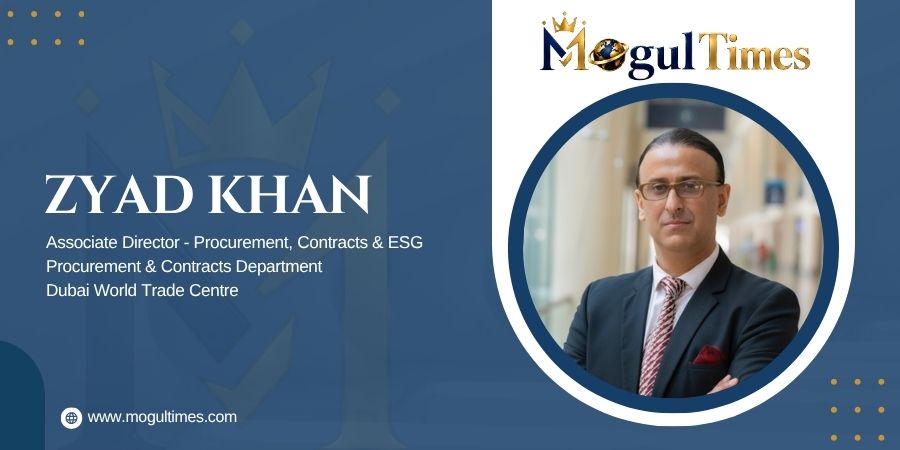
Zyad Khan: Reimagining Procurement as a Strategic Force for Resilient and Sustainable Growth
Procurement was once largely measured by one question: How much can an organization save?
Today, that question is no longer enough.
In a business environment shaped by global uncertainty, changing supplier markets, sustainability expectations, digital transformation, and increasingly complex operating models, procurement has moved much closer to the center of corporate strategy. The function is no longer simply responsible for buying goods and services. It influences resilience, risk, innovation, relationships, sustainability, and the ability of an organization to respond when circumstances change.
Few professionals understand that evolution through practical experience as deeply as Zyad Khan.
With more than 25 years of international experience across procurement and supply chain management, Khan has built his career around a simple but powerful principle: procurement should create value that remains visible long after a purchase order has been completed. His experience across aviation, government, corporate procurement, hospitality, IT facility management, FMCG, events, and large-scale strategic initiatives has given him a broad perspective on what modern procurement leadership truly requires.
His journey has taken him through demanding environments where efficiency, negotiation, supplier performance, operational continuity, and financial discipline must work together. At the same time, his growing focus on sustainability has expanded his view of procurement beyond immediate commercial results toward decisions that can support organizations and communities over the long term.
Beyond the Purchase Order
The strongest procurement leaders understand that every sourcing decision has consequences beyond price.
A supplier relationship can influence operational continuity. A contract can affect quality and customer experience. A sourcing decision can determine whether an organization is exposed to unnecessary risk—or prepared for disruption.
Khan’s approach reflects this wider understanding.
His expertise covers category management, sourcing methodologies, supplier relationship management, fleet optimization, and sustainability-focused procurement. Rather than viewing these areas as isolated responsibilities, he sees them as interconnected components of organizational performance.
That perspective becomes particularly important when procurement operates within complex organizations.
The cheapest option is not necessarily the most valuable one.
A lower-cost supplier may create quality challenges. A contract with attractive pricing may lack resilience. A sourcing decision that works today may become a problem when markets shift tomorrow.
Strategic procurement therefore requires a broader calculation—one that considers cost, quality, reliability, risk, sustainability, relationships, and long-term organizational priorities together.
Experience Built Across High-Stakes Environments
Khan’s professional journey has given him exposure to procurement situations where decisions carry significant operational consequences.
During his time with Emirates Airlines, he was involved in product-group responsibilities requiring disciplined sourcing, negotiation, and cost management. Later, as Procurement Manager for the Private Office of the Ruler of Dubai, he worked within an environment where procurement needed to balance organizational requirements with value, accountability, and supplier collaboration.
His professional experience has continued through the Dubai World Trade Centre’s MICE business, where his work has included developing procurement frameworks designed around sustainability and long-term objectives.
Large-scale projects and global flagship events hosted in Dubai further demonstrate the level of complexity he has encountered. They require careful planning, coordination, supplier management, resource optimization, and the ability to maintain standards while working under significant operational pressure.
These experiences have shaped Khan’s understanding of procurement as an operating discipline—one where preparation matters just as much as execution.
The New Procurement Equation
Procurement leadership is changing because the risks surrounding business are changing.
Supply disruptions, geopolitical developments, environmental pressures, changing regulations, technology shifts, and evolving stakeholder expectations have made resilience an essential part of procurement strategy.
For Khan, this creates an opportunity for procurement professionals to become more influential within the executive conversation. This broader strategic approach also reflects how modern business leaders increasingly connect organizational decisions with long-term value and market positioning.
The modern procurement leader must understand the business beyond procurement itself.
They need to understand how decisions affect finance, operations, sustainability, customers, employees, and strategic growth. They must be comfortable communicating with senior leadership while remaining close enough to operational realities to understand what actually works.
This is where experience becomes particularly valuable.
Years spent negotiating contracts or managing suppliers are important, but the deeper advantage comes from learning how different parts of an organization interact. Khan’s exposure to multiple industries has allowed him to develop precisely this broader perspective.
Sustainability With Commercial Discipline
Sustainability has also become an increasingly important part of Khan’s professional philosophy.
But sustainable procurement, in his view, should not exist as a separate corporate initiative disconnected from commercial realities. It must be integrated into the way organizations evaluate suppliers, manage resources, design processes, and make long-term decisions.
His certification in Environmental Sustainable Development Goals through the United Nations Institute for Training and Research (UNITAR) reflects this continued commitment to understanding the environmental dimension of procurement.
For Khan, responsible procurement is about finding the balance between economic performance and wider responsibility.
That means asking more meaningful questions.
Can resources be used more efficiently?
Can supplier relationships become more responsible?
Can procurement decisions support environmental objectives without compromising operational requirements?
Can organizations create value while reducing unnecessary waste?
These questions increasingly define the future of procurement.
Relationships Are Part of the Strategy
Procurement can sometimes be viewed as a function built around negotiation—one side trying to secure the best possible commercial terms from the other.
Khan’s career reflects a more collaborative view.
Strong supplier relationships can create value because they encourage transparency, improve communication, and make it easier for both parties to respond when circumstances change.
A supplier should not be viewed simply as an external party waiting to fulfill an order. In the right circumstances, suppliers can become sources of innovation, operational insight, flexibility, and long-term competitive advantage.
This is particularly important when organizations face unexpected disruption.
A relationship built only around price may not provide much support when problems arise. A relationship built around mutual understanding and clear expectations can become a strategic asset.
Khan’s emphasis on supplier relationship management reflects this broader philosophy, linking commercial performance with collaboration and long-term value creation.
Creating the Next Generation of Procurement Professionals
Khan’s influence extends beyond his direct professional responsibilities.
He has also invested time in education, mentoring, training, webinars, and industry discussions, helping develop procurement knowledge among professionals and students. His work includes mentoring postgraduate students at Heriot-Watt University and providing specialized training to professional cohorts through his ACTVET certification.
This aspect of his career is significant because procurement is changing faster than many traditional training models.
Future professionals will need more than technical knowledge.
They will need commercial awareness, analytical thinking, negotiation capability, sustainability literacy, digital confidence, and the ability to build meaningful relationships.
They will also need to understand that procurement is not simply about managing spend.
It is about understanding why an organization spends, where value can be created, and how decisions made today can strengthen the organization tomorrow.
Khan’s involvement in professional forums and collaborations with organizations including Kloepfel Consulting and The Procurement Channel further reflects his commitment to knowledge sharing and the development of stronger procurement practices.
Procurement as a Driver of Organizational Resilience
Perhaps the most important shift in procurement is the movement from a reactive function to a forward-looking one.
Reactive procurement asks, “How do we solve this requirement?”
Strategic procurement asks, “What could happen next, and how should we prepare?”
That difference changes everything.
It encourages organizations to understand supplier dependencies, identify vulnerabilities, diversify intelligently, improve forecasting, build stronger relationships, and connect procurement decisions with broader business priorities.
For Khan, this forward-looking mindset is central to the future of the profession.
Procurement leaders are increasingly expected to anticipate challenges rather than simply respond to them. They must understand markets, recognize emerging risks, identify opportunities, and create frameworks that allow organizations to remain adaptable.
This is why procurement deserves a stronger seat at the strategic table.
A Leadership Philosophy Built on Value
What distinguishes Khan’s career is not a single procurement achievement or one industry specialization. It is the breadth of his experience and the consistency of his approach.
Across different environments, his focus has remained connected to several core ideas: efficiency, sustainability, resilience, collaboration, and measurable value.
His professional credentials including Fellowship of Chartered Institute of Procurement and Supply UK (FCIPS) reinforce a commitment to professional standards, while his extensive practical experience has allowed him to apply those principles within complex operating environments.
The result is a perspective on procurement that feels increasingly relevant to the business world of 2026.
The profession is no longer operating quietly in the background.
It is helping organizations decide where to spend, whom to trust, how to manage risk, how to build resilient operations, and how to make sustainability commercially meaningful.
Looking Ahead
The future of procurement will belong to leaders capable of connecting immediate business requirements with long-term organizational purpose.
Technology will continue to reshape sourcing and supplier management. Sustainability expectations will become more demanding. Supply networks will remain exposed to disruption. Data will influence decisions more deeply. And organizations will increasingly expect procurement teams to contribute directly to strategic growth.
In this changing environment, Zyad Khan represents a generation of procurement leaders who understand that value cannot be reduced to a number on a spreadsheet.
Sometimes value is measured in savings.
Sometimes it is measured in resilience.
Sometimes it appears through a stronger supplier relationship, a more responsible sourcing decision, a more efficient process, or a team better prepared to handle tomorrow’s challenges.
The real achievement is knowing how all of those elements fit together.
That is what makes procurement influential.
And that is the space in which Zyad Khan continues to shape the future of procurement—one defined not merely by what organizations buy, but by how intelligently, responsibly, and strategically they create value.