
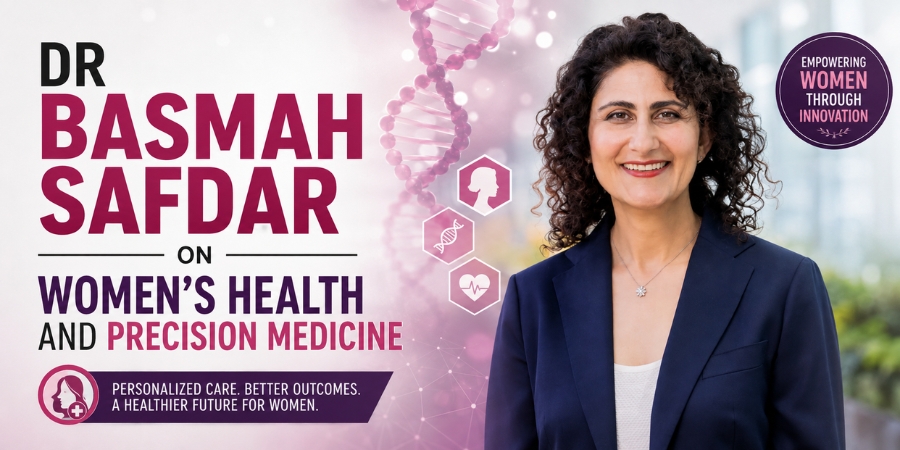
Basmah Safdar women’s health work is putting precision medicine at the center of a broader effort to improve how sex-based biological differences are understood and addressed in health care. In an August 18, 2026 Q&A published by Yale School of Medicine, Safdar discussed her call for stronger science, organizational change and new funding approaches to advance women’s health research and clinical care.
Safdar, MD, is director of Women’s Health Research at Yale and a physician-scientist. Her position is that women’s health should be approached through a precision-medicine framework that accounts for biological differences when developing diagnostics, prognostics and treatments.
Why Basmah Safdar’s Women’s Health Approach Focuses on Precision
According to Safdar, insufficient sex-specific data can contribute to missed or delayed diagnoses and less effective treatment. She argues that medical care should account for differences in how women and men may experience disease and respond to medications.
Her experience as an emergency physician also informs that perspective. Safdar described the importance of selecting diagnostic evaluations that do not dismiss potentially serious conditions because a woman describes symptoms differently, while also considering physiological differences in medication metabolism.
The approach extends beyond separating research results by sex. Safdar is calling for research that examines female biology across multiple systems and stages of life, supported by collaboration among different academic disciplines.
KINETIC Brings Yale Researchers Together
A central part of the Basmah Safdar women’s health strategy is KINETIC, described by Safdar as a one-year experiment designed to bring interdisciplinary groups together around biology-focused topics.
The initiative draws on the Women’s Health Research at Yale Collaborative, which spans more than 40 departments. Its first pilot, KINETIC: Aging & Longevity, focuses on aging in women’s health through midlife and the menopause transition. Safdar is co-chairing the pilot with Lubna Pal, MD.
The model is intended to connect expertise across Yale so that complex questions involving female biology can be examined from multiple perspectives and translated toward patient care. Safdar said additional KINETIC cohorts could follow if the first effort succeeds.
A New Funding Model for Women’s Health Research
Safdar also highlighted what she calls a “reverse pitch” approach to innovation. Rather than waiting for scientific work to move sequentially from foundational research toward commercial interest, the model would invite foundations, industry partners and investors to bring validated needs or market signals to an interdisciplinary research center early in the process.
For Basmah Safdar women’s health research, the proposed approach is intended to create stronger connections between scientific discovery, clinical needs and potential translation. Safdar also cautioned that increased investment should produce sustained discovery rather than allow women’s health to become another short-lived investment trend.
From Research Gaps to Broader Health Impact
Safdar’s argument places women’s health within the larger framework of precision medicine rather than treating it as a narrow specialty. She says a deeper understanding of sex differences, interdisciplinary research and better-supported translation could improve health care for women while also contributing to broader health outcomes.
The Basmah Safdar women’s health vision also includes education and collaboration. The Women’s Health Research at Yale Collaborative remains open to members of the Yale community, from undergraduate students through faculty, reflecting the cross-disciplinary structure Safdar says is necessary to move research toward practical impact.
Basmah Safdar women’s health advocacy ultimately centers on changing how biological differences are incorporated into research and routine care. Her Yale School of Medicine discussion presents precision medicine, interdisciplinary collaboration and alternative funding pathways as interconnected elements of that effort.
This news has been compiled using information gathered from various platforms and is intended for general informational purposes only.