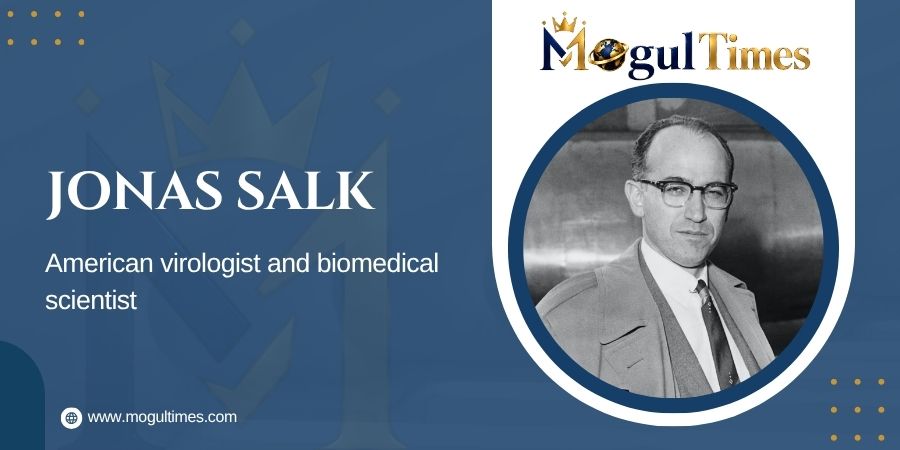
Jonas Salk’s polio vaccine transformed one of the most feared infectious diseases of the 20th century into a preventable disease, and his decision not to pursue a patent helped preserve the idea that the breakthrough belonged to the public. Salk’s inactivated poliovirus vaccine was declared safe, effective and potent on April 12, 1955, after a massive field trial involving roughly 1.8 million children and other participants.
The achievement was not the work of one scientist alone. Salk built on decades of virology research, the identification of poliovirus types, advances in tissue culture, and financial support from the March of Dimes. But his leadership gave the effort a decisive direction: instead of weakening the virus while keeping it alive, his team developed a vaccine using poliovirus that had been chemically inactivated with formaldehyde.
The result changed public health in the United States and eventually contributed to a worldwide campaign against polio.
Why Was Polio Such a Major Threat?
Polio was a major public-health threat because poliovirus could spread silently while occasionally invading the nervous system and causing permanent paralysis or death. During the first half of the 20th century, increasingly severe outbreaks terrified families, particularly during summer months when cases often surged. The United States experienced more than 21,000 paralytic cases in 1952 alone, the peak of its polio epidemic.
The disease was especially frightening because there was no reliable cure. Children who survived severe infection could be left with lifelong disabilities, while some patients required mechanical assistance to breathe.
The 1952 epidemic demonstrated the scale of the crisis:
- More than 57,000 total polio cases were reported in the United States.
- More than 21,000 cases involved paralysis.
- Families feared swimming pools, playgrounds and other places where transmission might occur.
- Public-health authorities urgently needed an effective preventive vaccine.
This environment created enormous pressure for researchers to find a solution.
The March of Dimes became an important financial force behind the search for a vaccine. Millions of Americans contributed to the organization, helping fund research, laboratories and eventually the enormous field-testing program that would determine whether Salk’s vaccine worked.
How Did Jonas Salk Develop the Polio Vaccine?
Jonas Salk developed his polio vaccine by using chemically inactivated poliovirus to stimulate immunity without using live, disease-causing virus. His approach differed from researchers pursuing live attenuated vaccines and depended heavily on earlier discoveries about poliovirus and laboratory cultivation.
Salk was born in New York City in 1914 and trained as a physician and medical researcher. His work eventually brought him to the University of Pittsburgh, where he concentrated on viruses and vaccine development.
A critical scientific foundation had already emerged before Salk’s breakthrough. Researchers had identified three major poliovirus serotypes, while John Enders, Thomas Weller and Frederick Robbins demonstrated that poliovirus could be cultivated in human tissue cultures. Their 1948 discovery became an important enabling technology for later vaccine research and earned them the 1954 Nobel Prize in Physiology or Medicine.
Salk’s central insight was that a virus did not necessarily need to remain alive to teach the immune system what to recognize.
His team treated poliovirus with formaldehyde, killing the virus while preserving its antigenic properties—the features the immune system could recognize and respond to. This produced an inactivated poliovirus vaccine, commonly known as IPV.
Before the vaccine moved toward mass use, Salk and his colleagues conducted smaller safety and immune-response studies. Salk also tested the vaccine within his own family, a detail that has become part of the story of his confidence in the approach.
The decisive test, however, would involve hundreds of thousands of children.
What Happened During the Historic 1954 Polio Vaccine Trial?
The 1954 Salk vaccine field trial became one of the largest medical experiments of its time, involving approximately 1.8 million children and extensive participation from physicians, nurses, teachers, health officials and volunteers.
The scale was extraordinary.
Researchers organized the trial across thousands of schools and communities. About 650,000 children received injections containing either vaccine or placebo, while another approximately 1.18 million children served as controls. The study involved three injections and subsequent monitoring, requiring an enormous national coordination effort.
The children who participated became known as “Polio Pioneers.”
The trial used a controlled design that allowed researchers to compare vaccinated children with children who received placebo injections or served as controls. This was essential because researchers needed evidence strong enough to establish whether the vaccine actually prevented polio rather than simply appearing promising in laboratory studies.
The results were historic.
On April 12, 1955, researchers announced that the vaccine had been shown to be safe, effective and potent against the three poliovirus types targeted by the vaccine.
The announcement became a national celebration.
For Americans who had spent years watching children become paralyzed or die from polio, the news represented something more than a scientific achievement. It represented the possibility of removing a persistent source of fear from everyday life.
Why Didn’t Jonas Salk Patent the Polio Vaccine?
The Jonas Salk polio vaccine story is often remembered for the claim that Salk refused to patent his vaccine, but the more accurate historical explanation is that the vaccine was not patented and Salk expressed a strong public-ownership philosophy about the discovery. When journalist Edward R. Murrow asked Salk who owned the patent in 1955, Salk famously replied that he considered it to belong to the people and asked, “Could you patent the sun?”
The distinction matters.
Salk did not simply possess a completed patent and then formally surrender it. Lawyers associated with the National Foundation for Infantile Paralysis had examined patent possibilities, but the vaccine was not patented. Salk was reluctant to treat the discovery as private intellectual property, particularly because the research and testing had benefited substantially from public fundraising through the March of Dimes.
That context makes his famous statement more significant.
The vaccine had emerged from a broad social effort:
- Families donated to the March of Dimes.
- Scientists contributed years of research.
- Physicians and nurses participated in testing.
- Teachers and schools helped organize the field trial.
- Millions of children participated.
- Public institutions helped establish safety and regulatory systems.
Salk therefore viewed the achievement as something larger than an individual commercial invention.
His position became an enduring example of the tension between scientific discovery and intellectual property. A patented medical breakthrough can generate enormous commercial value, but unrestricted access can also accelerate public-health benefits.
The phrase “Could you patent the sun?” captured Salk’s philosophy in a single memorable image.
Did Salk’s Vaccine Really Save Millions of Lives?
The Salk vaccine played a foundational role in dramatically reducing polio, although it is more precise to describe its impact in terms of preventing disease, paralysis and deaths rather than attributing every subsequent life saved to Salk alone. After IPV was introduced in 1955, U.S. polio incidence fell sharply, and the decline continued after oral polio vaccine was introduced in 1961.
The scale of the transformation can be seen in the numbers.
| Period | Polio situation in the United States |
|---|---|
| 1952 | More than 57,000 total reported cases |
| 1952 | More than 21,000 paralytic cases |
| 1955 | Inactivated polio vaccine introduced |
| 1960 | 2,525 paralytic cases reported |
| 1965 | 61 paralytic cases reported |
| 1979 | Last U.S. outbreak of wild poliovirus acquired domestically |
The reduction was not caused by one person or one vaccine alone. Public vaccination programs, improvements in surveillance, later use of oral polio vaccine, stronger manufacturing standards and international immunization campaigns all contributed.
Still, Salk’s IPV was a crucial turning point.
Within seven years of the vaccine’s introduction, the incidence of polio in the United States had fallen by about 97 percent, according to historical accounts. By 1959, the vaccine had reached approximately 90 countries.
That is why the Jonas Salk polio vaccine story remains important: it illustrates how a scientific breakthrough can move rapidly from laboratory research to population-level protection when research, public participation and large-scale vaccination work together.
What Was the Cutter Incident?
The Cutter Incident showed that even a successful vaccine can create serious danger if manufacturing controls fail, leading to stronger vaccine-production oversight in the United States. In 1955, some vaccine lots manufactured by Cutter Laboratories contained inadequately inactivated poliovirus, and the resulting cases included paralysis and deaths.
The incident was a devastating setback.
The vaccine itself had passed the scientific evaluation that established its effectiveness, but manufacturing failures allowed live poliovirus to remain in some batches.
CDC historical records document that the incident led to hundreds of cases and prompted an urgent investigation and recall. The episode ultimately helped drive stricter controls over vaccine production and federal oversight.
This part of the story is important because it demonstrates that vaccine development does not end when a clinical trial succeeds.
A vaccine must also be:
- Manufactured consistently.
- Tested for safety.
- Distributed under controlled conditions.
- Monitored after introduction.
- Supported by effective public-health surveillance.
The Cutter Incident became a landmark in the history of pharmaceutical regulation precisely because it exposed what could happen when production controls failed.
How Did Salk’s Work Change the Fight Against Polio?
Salk’s work changed the fight against polio by converting prevention from an aspiration into a scalable public-health strategy. IPV became the first widely used effective polio vaccine, and vaccination programs dramatically reduced transmission and disease in the United States before subsequent vaccines expanded the global effort.
The scientific legacy extended beyond the United States.
By reducing susceptibility to poliovirus, vaccination campaigns made it increasingly difficult for the virus to circulate. Oral polio vaccine later became particularly important for mass campaigns because it could be administered easily and helped interrupt transmission.
The combined impact was enormous.
Today, wild poliovirus has been eliminated from the United States, although polio remains a global eradication challenge. CDC notes that wild poliovirus has been eliminated in the United States because of vaccination, while poliovirus transmission continues to require international surveillance and immunization efforts.
Two poliovirus types have been declared eradicated globally: type 2 in 2015 and type 3 in 2019. Wild poliovirus type 1 remains the focus of global eradication efforts.
What Is the Greatest Lesson From the Jonas Salk Polio Vaccine Story?
The greatest lesson from the Jonas Salk polio vaccine story is that transformative medical progress can emerge when scientific persistence, public investment, rigorous testing and a commitment to broad access converge. Salk became famous, but the vaccine was built on a much larger ecosystem of researchers, donors, volunteers, clinicians and public-health institutions.
Salk’s legacy therefore goes beyond a single injection.
His career raises enduring questions about how society should reward scientists, fund biomedical research and decide who benefits from lifesaving discoveries.
The vaccine demonstrates several principles that remain relevant:
- Scientific breakthroughs build on earlier discoveries.
- Large-scale clinical evidence is essential before mass adoption.
- Manufacturing quality is as important as laboratory science.
- Public participation can accelerate medical progress.
- Access to lifesaving technologies can have consequences far beyond commercial value.
- Eradication requires sustained vaccination and surveillance, not one breakthrough alone.
Salk died in 1995, but the public-health consequences of his work continue to shape medicine.
His story is especially powerful because the central achievement was not simply discovering a vaccine. It was demonstrating what could happen when scientific knowledge was turned into a tool for protecting entire populations.
Frequently Asked Questions
Did Jonas Salk invent the polio vaccine?
Jonas Salk developed the first successful widely used inactivated polio vaccine, which was licensed in the United States in 1955. His work depended on earlier advances in poliovirus research, including the cultivation of poliovirus in human tissue cultures and identification of the virus’s three serotypes.
Why didn’t Jonas Salk patent his vaccine?
The vaccine was not patented, and Salk expressed the view that the achievement belonged to the public. When Edward R. Murrow asked about ownership in 1955, Salk famously responded by comparing the vaccine to the sun. Historical accounts indicate that patenting had been considered but was not pursued.
How many children participated in the Salk vaccine trial?
Approximately 1.8 million children participated in the landmark 1954 field trial. About 650,000 received vaccine or placebo injections, while roughly 1.18 million served as controls.
Is polio still a problem today?
Polio has been eliminated from the United States, but global eradication has not yet been achieved. Wild poliovirus types 2 and 3 have been declared eradicated, while wild poliovirus type 1 continues to circulate in limited areas, making vaccination and surveillance essential.
Conclusion: A Discovery That Belonged to Everyone
Jonas Salk’s polio vaccine became one of the defining medical breakthroughs of the 20th century because it transformed a disease associated with fear and paralysis into one that could be prevented through vaccination. The vaccine’s development required years of scientific work, enormous public participation and an unprecedented clinical trial.
Salk’s decision not to pursue a patent became inseparable from that achievement.
Whether remembered through his famous “patent the sun” remark or through the millions of people protected by polio vaccination, Salk represents a model of scientific achievement measured not only by discovery, but by public impact.
His most enduring legacy may be the principle behind the breakthrough: when lifesaving science is treated as a public good, its value can extend far beyond the laboratory.
Also Read: Patricia Bath Inspiring Story: A Legacy That Changed Vision Forever