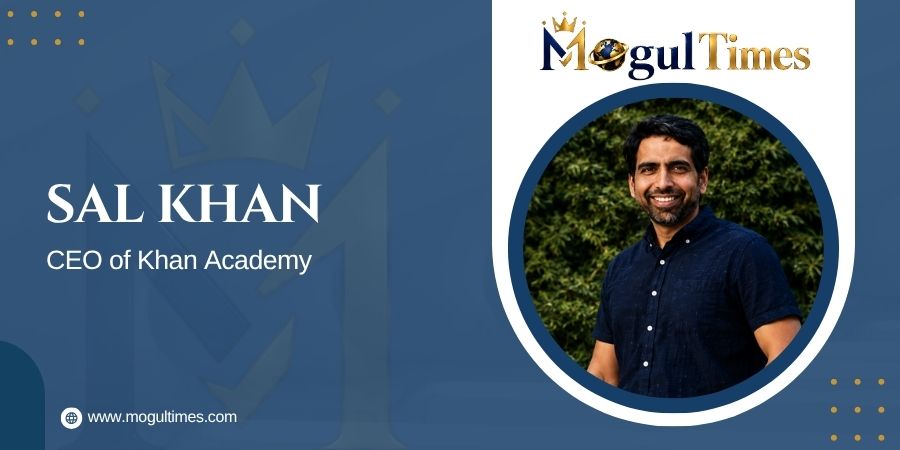
The Sal Khan Academy story began with a simple tutoring problem, not a plan to build a global education company. In 2004, Sal Khan, then working in finance, began remotely tutoring his cousin Nadia in mathematics after she struggled with unit conversion. What started as one-on-one help eventually became Khan Academy, a nonprofit education platform whose mission is to provide a free, world-class education to anyone, anywhere.
The name can cause confusion because Sal Khan’s full name is Salman Amin Khan. He is not the Bollywood actor Salman Khan. Sal Khan studied at MIT and Harvard and worked as a hedge fund analyst before turning his growing collection of online math lessons into a full-time educational organization.
How did Sal Khan start Khan Academy?
Sal Khan started Khan Academy by tutoring his cousin Nadia remotely in 2004, using a telephone and Yahoo Doodle while he was living and working in Boston and she was in New Orleans. The arrangement worked because Nadia could receive individualized help without being physically in the same location. As her performance improved, other relatives began asking Khan for tutoring as well.
The early experience revealed a larger problem: traditional tutoring was difficult to scale because one person could only help a limited number of students at a time. Khan therefore began looking for a way to explain the same concepts repeatedly without having to deliver the lesson personally every time.
The solution was recorded video.
In 2006, Khan began posting instructional videos on YouTube so his cousins could watch them whenever they needed help. The videos quickly attracted viewers beyond his family. Instead of answering the same mathematical question repeatedly, Khan could create one explanation and make it available to anyone with an internet connection.
That decision became the technological foundation of Khan Academy.
Why did tutoring videos become a global education platform?
The key breakthrough was turning personalized tutoring into reusable educational content that could reach thousands, then millions, of learners. Khan’s videos allowed students to pause, replay and review explanations at their own pace, while the growing platform eventually added practice exercises, assessments and personalized learning tools.
The model also challenged a basic assumption about education: that high-quality instruction must always be delivered synchronously by a teacher standing in front of a classroom.
Khan Academy instead built around several principles:
- Self-paced learning: Students can revisit concepts when necessary.
- Mastery: Learners can practice skills rather than simply watch lessons.
- Accessibility: Core learning resources are available without traditional tuition costs.
- Scalability: One instructional resource can serve learners across different locations.
- Teacher support: Educators can use the platform to supplement classroom instruction.
- Personalized progress: Learning dashboards and exercises help students identify areas requiring more practice.
Khan Academy now describes itself as a nonprofit organization focused on providing free education rather than operating primarily through advertising or conventional subscriptions.
When did Khan Academy become a full-time mission?
Khan Academy became Sal Khan’s full-time focus in 2009, after he left his hedge fund career and committed himself to developing the educational project. Before that point, he had been creating lessons while continuing his finance work.
The transition represented a significant personal and professional risk. Khan had already built an established career in finance, but the growing audience for his educational videos convinced him that the project could become something much larger.
The organization was incorporated as a 501(c)(3) nonprofit in 2008. In 2010, major grants from Google and the Bill & Melinda Gates Foundation helped Khan Academy expand its team and technology infrastructure.
The transformation was therefore gradual:
| Stage | Development |
|---|---|
| 2004 | Khan begins tutoring cousin Nadia remotely |
| 2006 | Educational videos begin appearing on YouTube |
| 2008 | Khan Academy becomes a nonprofit organization |
| 2009 | Khan leaves finance to pursue the project full time |
| 2010 | Major philanthropic funding accelerates expansion |
| Today | Khan Academy operates as a global nonprofit learning platform |
The significance of this timeline is that Khan Academy did not begin with a giant technology platform. It began by solving one learner’s immediate problem.
What makes Khan Academy different from traditional tutoring?
Khan Academy’s major distinction is that it combines free instructional content with practice and personalized learning rather than relying exclusively on live, one-to-one teaching. Its platform covers subjects ranging from mathematics and science to computing, economics, reading, history and test preparation.
The underlying educational philosophy is particularly important.
A student who does not understand fractions, algebra or another foundational concept may struggle with increasingly advanced material. Khan Academy attempts to let learners identify those gaps and work on them before progressing.
Its learning model can be summarized as:
Learn → Practice → Identify gaps → Review → Master → Progress
That approach has helped turn the platform from a collection of videos into a broader learning environment.
The platform is also designed to support teachers and parents, meaning Khan Academy is not positioned simply as a replacement for schools. Instead, its resources can complement classroom teaching by giving learners additional opportunities to practice concepts outside scheduled lessons.
How large is Khan Academy today?
Khan Academy has grown from a family tutoring experiment into a platform used by more than 100 million learners in a school year, with access spanning more than 190 countries and more than 55 languages. Khan Academy’s latest published figures report 227 million registered users and 75 billion learning minutes overall, while 104.9 million learners used the platform during the 2024–25 school year.
Its 2024–25 annual report provides additional scale indicators:
- 189.6 million registered users in the annual-report measurement period
- 104.9 million yearly active learners
- 66.8 billion learning minutes
- 20.9 million new registered users during the school year
- 1.7 million yearly proficient learners
- 2 million total global Khanmigo users with access during the period
These numbers show the scale of the transformation. A tutoring relationship involving one cousin became an educational infrastructure used by learners around the world.
Why is the Khan Academy model important for global education?
The model matters because it addresses one of education’s biggest structural challenges: quality learning resources are difficult to distribute equally when access depends on geography, school resources or household income.
Khan Academy’s mission is explicitly built around free access. Its platform gives students the ability to study outside normal classroom hours and revisit foundational concepts without paying for every additional lesson.
The international expansion also demonstrates how digital education can be adapted to local needs. Khan Academy’s India platform, for example, offers free Grade 1–12 content aligned with the Indian curriculum and makes resources available in English, Hinglish, Hindi, Gujarati, Assamese, Odia, Marathi, Punjabi and Kannada.
This localization is important because simply translating an American educational resource does not automatically make it appropriate for students in another country. Curriculum alignment, language and cultural context all influence whether digital education is genuinely useful.
What can entrepreneurs learn from Sal Khan’s journey?
The Sal Khan Academy story demonstrates that large-scale innovation can emerge from solving a narrow problem extremely well. Khan did not initially set out to build a global education platform; he was trying to help one family member understand mathematics.
Several principles stand out from the journey:
Start with a real problem
Nadia’s difficulty with mathematics created the initial use case. The project evolved because the solution worked for a real learner rather than because Khan began with a theoretical business concept.
Build something reusable
Live tutoring solved Nadia’s immediate problem but did not scale. Recorded lessons allowed Khan to solve similar problems for many learners simultaneously.
Follow evidence from users
The growing audience for Khan’s videos demonstrated that people beyond his family found the teaching format useful. That response helped guide the project’s expansion.
Keep the mission bigger than the technology
Khan Academy’s technology has evolved significantly, but its central mission remains free, world-class education for anyone, anywhere.
Think globally after proving local value
The original audience was essentially one family. The eventual audience became global. The progression shows why solving a small problem effectively can sometimes reveal a much larger opportunity.
How is Khan Academy evolving with artificial intelligence?
Khan Academy is increasingly using artificial intelligence to expand personalized learning through tools such as Khanmigo, an AI-powered tutor and teaching assistant. The organization’s annual report says 2 million users globally had access to Khanmigo during the 2024–25 school year.
The objective is not simply to provide students with automated answers. Khan Academy has emphasized using AI to support guided learning, questioning and personalized assistance while maintaining the educational role of teachers.
This represents the next stage of the original idea: if recorded lessons allowed one tutor to reach millions of learners, AI could potentially make educational interaction more individualized at much larger scale.
The challenge is ensuring that technology improves learning rather than merely making information easier to obtain. Effective education still requires motivation, feedback, practice, conceptual understanding and human guidance.
What is the biggest lesson from the Sal Khan Academy story?
The biggest lesson is that scale does not always require starting big; it can come from designing a solution that naturally expands beyond its original user. Sal Khan began with one cousin, converted his explanations into videos, responded to growing demand and eventually built a nonprofit platform serving learners worldwide.
The journey also illustrates the power of distribution. Khan’s mathematical knowledge alone would not have created global impact. The combination of teaching ability, digital video, internet distribution, free access and later learning technology transformed that knowledge into a resource that could be reused by millions.
That is what makes the story particularly relevant to entrepreneurs and education innovators: the breakthrough was not simply creating educational content. It was creating a system through which educational content could travel far beyond the person who originally needed it.
FAQ
Is Sal Khan the founder of Khan Academy?
No. The founder of Khan Academy is Sal Khan, whose full name is Salman Amin Khan. He founded the organization after beginning to tutor his cousin Nadia remotely in mathematics in 2004. He is different from Indian actor Salman Khan.
How did Sal Khan start Khan Academy?
Sal Khan started by tutoring his cousin Nadia by telephone and Yahoo Doodle in 2004. After other relatives began seeking his help, he started recording lessons and uploading them to YouTube in 2006, allowing many learners to access the same explanations.
Is Khan Academy really free?
Yes. Khan Academy operates as a nonprofit and states that its mission is to provide a free, world-class education to anyone, anywhere. Its core learning resources are available free of charge.
How many people use Khan Academy?
Khan Academy reports more than 100 million learners using the platform during the 2024–25 school year. Its latest published platform figures also report 227 million registered users and 75 billion learning minutes overall.
Conclusion
The Sal Khan Academy story is ultimately a story about turning one person’s tutoring problem into a global education mission. Sal Khan began with a cousin who needed help with math, discovered that recorded explanations could reach far more students than live tutoring, and built those lessons into a nonprofit learning platform used across the world.
The journey offers a powerful model for modern innovation: solve a genuine problem, make the solution reusable, listen to users, and build distribution into the solution itself. Khan Academy’s evolution from a family tutoring experiment to a global education platform shows how a small intervention can become transformational when technology and mission reinforce each other.
For entrepreneurs, educators and creators, the lesson is simple: the next global idea may begin with solving one person’s problem exceptionally well.
Also Read: The Malala Yousafzai Journey That Redefined Courage and Education