
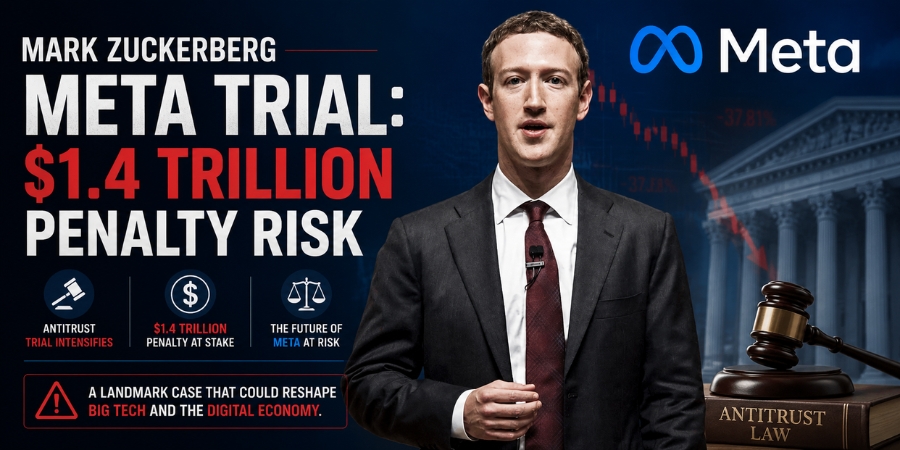
Mark Zuckerberg Meta trial developments have put Meta Platforms under intense legal and investor scrutiny, with four U.S. states seeking penalties that Meta says could reach $1.4 trillion if the company loses a case alleging that Facebook and Instagram were designed to encourage compulsive use among young people. The figure is roughly comparable to Meta’s market capitalization, according to the company’s court filings reported by Bloomberg and The Economic Times.
The case adds to a difficult period for Meta, whose shares have also faced pressure over the company’s heavy spending on artificial intelligence infrastructure and questions about how quickly those investments will generate returns. The legal dispute therefore represents both a regulatory challenge and a significant issue for investors evaluating Meta’s future business outlook.
Why the Mark Zuckerberg Meta trial matters to Meta
The lawsuit involves Meta Platforms, the parent company of Facebook and Instagram. California, Colorado, Kentucky and New Jersey are pursuing claims that Meta deceived the public about the safety of its platforms and designed them in ways that encouraged compulsive use among young users.
Meta has rejected the allegations. A company spokesperson told Bloomberg News that the states’ claims were unsubstantiated and that their financial demands were disproportionate. Meta also said it stands by its record of creating protections for teenagers and intends to defend itself in court.
The Mark Zuckerberg Meta trial is significant because the potential financial exposure cited by Meta is unusually large. The company said the states’ calculation could result in penalties of as much as $1.4 trillion, although the amount represents the states’ claimed potential penalties rather than a judgment already imposed by a court.
Meta shares react as legal pressure builds
Investors have already responded to the trial and wider concerns surrounding Meta. The company’s shares dropped 4.5% on Tuesday when the trial began, following a 3.5% decline on Monday. The stock recovered modestly on Wednesday but remained down nearly 18% for the year at the time of the report.
The broader technology market has performed considerably better during the same period. According to the report, the Nasdaq 100 was up 16% in 2026, while Meta was among the weakest performers in the index.
For investors watching the Mark Zuckerberg Meta trial, the concern extends beyond the size of a possible penalty. Portfolio manager Neville Javeri of Allspring Global Investments said the potential liability is difficult to assess, while warning that investors need to consider the risk because Meta itself has disclosed the large figure.
AI spending adds another layer of pressure
Meta’s legal battle comes while the company is committing enormous sums to artificial intelligence infrastructure. The company is expected to spend about $139 billion on capital expenditures in 2026, nearly twice its 2025 total of $69.7 billion, according to analyst estimates compiled by Bloomberg. Estimates put spending at approximately $197 billion in 2027 and $212 billion in 2028.
That spending has reduced Meta’s free cash flow outlook and contributed to investor concerns about the company’s financial trajectory. Earnings-per-share estimates for 2026 and 2027 have also declined over the previous month, according to Bloomberg data cited in the report.
Some shareholders nevertheless view AI investment differently from Meta’s earlier metaverse push. Stephen Lee of Logan Capital Management argued that AI is already supporting advertising revenue and has broader commercial applications, making the current investment cycle different from the company’s metaverse strategy.
What the Mark Zuckerberg Meta trial could mean for the company
The central issue for investors is not simply whether Meta could face a large financial penalty. A ruling that forces meaningful changes to how Facebook and Instagram operate could affect the company’s growth model, according to Javeri.
The legal pressure also follows other developments involving social-media safety. The report noted that a New Mexico jury in March found Meta had misled teenagers about the safety of its social networks, while a Los Angeles jury found Meta and Google liable in a case involving social-media addiction. Governments in Australia and Europe have also pursued restrictions aimed at protecting children online.
For Mark Zuckerberg Meta trial watchers, these developments make the case an important test of the legal risks surrounding major social-media platforms. At the same time, the $1.4 trillion figure should be understood as a potential penalty calculation described by Meta, not as an amount that a court has ordered the company to pay.
Meta’s stock also trades at a substantially lower earnings multiple than earlier in the year, leaving investors divided over whether the lower valuation adequately reflects the company’s legal, spending and growth risks.
This news has been compiled using information gathered from various platforms and is intended for general informational purposes only.